Claims routed to the right desk, with the evidence attached.
First notice of loss, photos, police reports and policy wording arrive together. REMIT reads them, fast-tracks the claims that clearly qualify, and sends the rest to an adjuster with coverage clauses already cited.
- Workflow
- Claims routing and complaint triage
- Regimes mapped
- PDPAMAS NoticesEU AI ActDORA
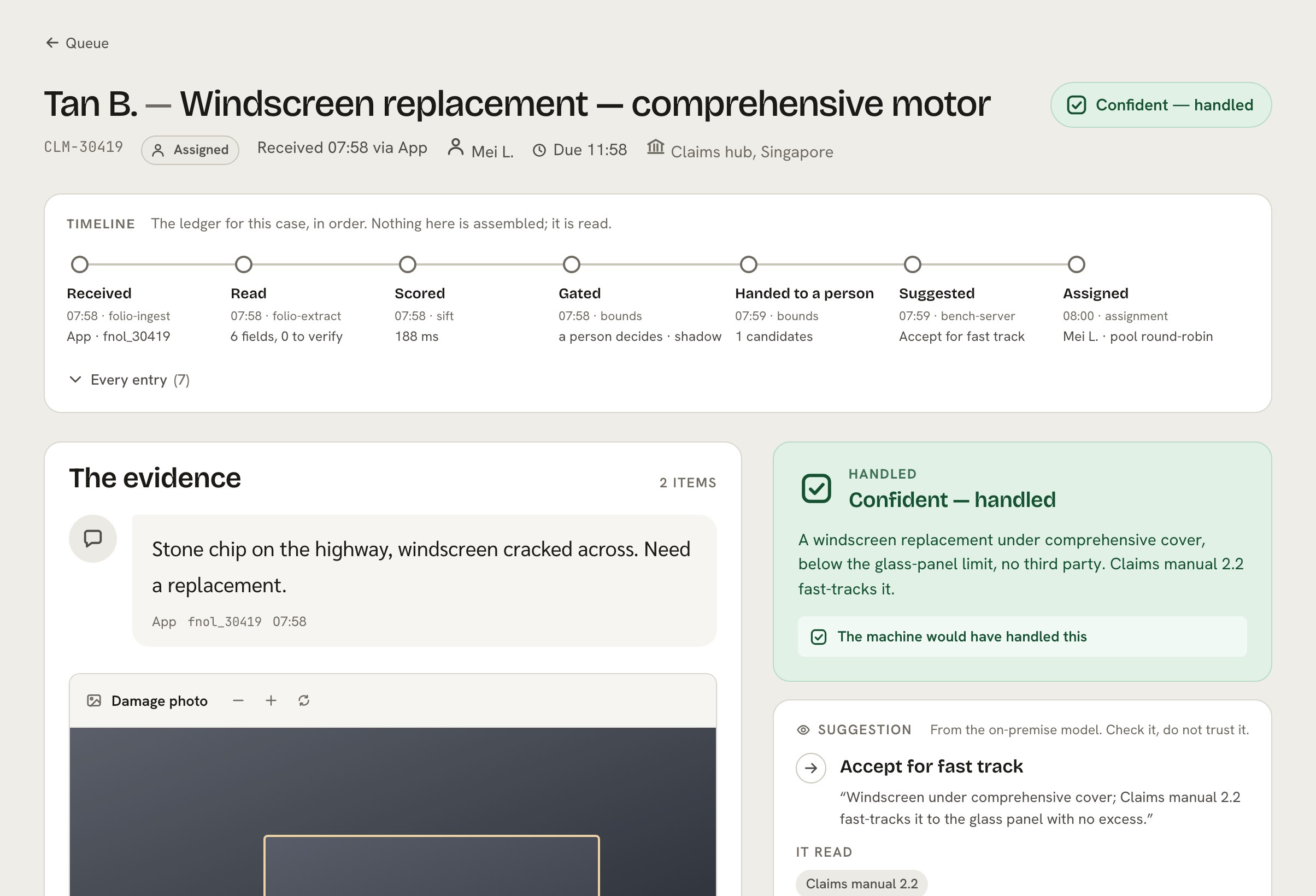
Captured from the REMIT console demonstrator; the case data and figures are illustrative
Routing is high-volume and does not settle the claim, which makes it the right place to start: large savings in handling time, no machine deciding what a customer is paid.
Illustrative scenario
A morning with REMIT
08:15
A claim is lodged through the app
A policyholder uploads four photos, a police report and the incident description for a rear collision. REMIT reads the report, matches the vehicle and policy, and pulls the coverage clause and the claims manual section that apply.
08:16
Clearly within cover
Comprehensive policy, damage consistent with the report, within limits, no prior claims flagged. The case is routed to fast-track and recorded. The adjuster sees it in the handled band, with the clauses it relied on.
08:40
Another claim, less clear
Water damage where the excess depends on how the leak started. REMIT cannot separate standard adjustment from a document request, so it hands off to an adjuster with both options, the policy wording, and the two photos that would settle it.
09:05
The adjuster decides
She requests the plumber’s report using the pre-filled message, and the case waits on the customer with its due date visible. When it settles, a signed record shows what was read, what was chosen, and by whom.
The reviewer’s daily surface
What your case officers see
Cases arrive already read, with the outcome the system is sure of or the two it could not separate. Nothing on this screen is a probability; the state is the confidence.
Needs you 3
- Verify
Lim S.
Rear collision — third-party report attached
Likely — please verify.
- Hand off
Rahman A.
Water damage — policy excess unclear
Not sure — a person is on it. “Standard adjust” or “Request documents”
- Refer
Ong K.
Loss abroad, currency mismatch
I have not seen a case like this.
Handled without you this morning 168
- Handled
Tan B.
Windscreen replacement — comprehensive motor
This is taken care of. Here is why.
What changes
For your team
The queue shrinks to what needs judgement.
Routine cases are cleared and filed with their evidence. Your people open the ones where two outcomes are possible, with the evidence already assembled.
Deadlines stop being a scramble.
Every open case shows what would make it decidable and when it is due. Requests to the customer are pre-filled from what is missing.
Audit preparation is already done.
Each decision carries a signed record: what was read, what was decided, by whom, against which standard. Export it; nothing to reconstruct.
What stays with people
- Settlement amounts and declines, always
- Any claim where two routes are plausible
- Suspected fraud referrals
REMIT routes claims; it does not settle or decline them. Those options are not in the list it can choose from, so the platform cannot select them.
What you get
Delivered inside your environment
- Document intake for your channels and formats
- A model trained and measured on your own past cases
- Your list of outcomes and decision rules, agreed with your experts
- The reviewer console for your case officers
- A signed proof record on every decision
- A compliance package mapped to your regime
What the regulator gets
Every decision carries a signed record: what was read, what was decided, by whom, and against which standard. Verifiable with your own key, without us in the room.
How to start
Two weeks in shadow mode, on your own insurance cases.
REMIT is installed on one server inside your perimeter, reads and scores every live case, and executes nothing. Your people decide everything. After two weeks you read how often they agreed with it, per outcome, before licensing anything.
Ready to scope an engagement?
A 30-minute call. From there, the first paid step is an Air-gap readiness assessment or a Discovery engagement.
Start a conversation