Complaints and alerts, cleared with proof.
Customer complaints and monitoring alerts arrive as free text, slips and statements. REMIT reads them, resolves the routine ones against your fee schedule and SOPs, and hands the rest to a case officer with the evidence assembled.
- Workflow
- Complaint and alert disposition
- Regimes mapped
- MAS TRMPDPASR 11-7EU AI Act
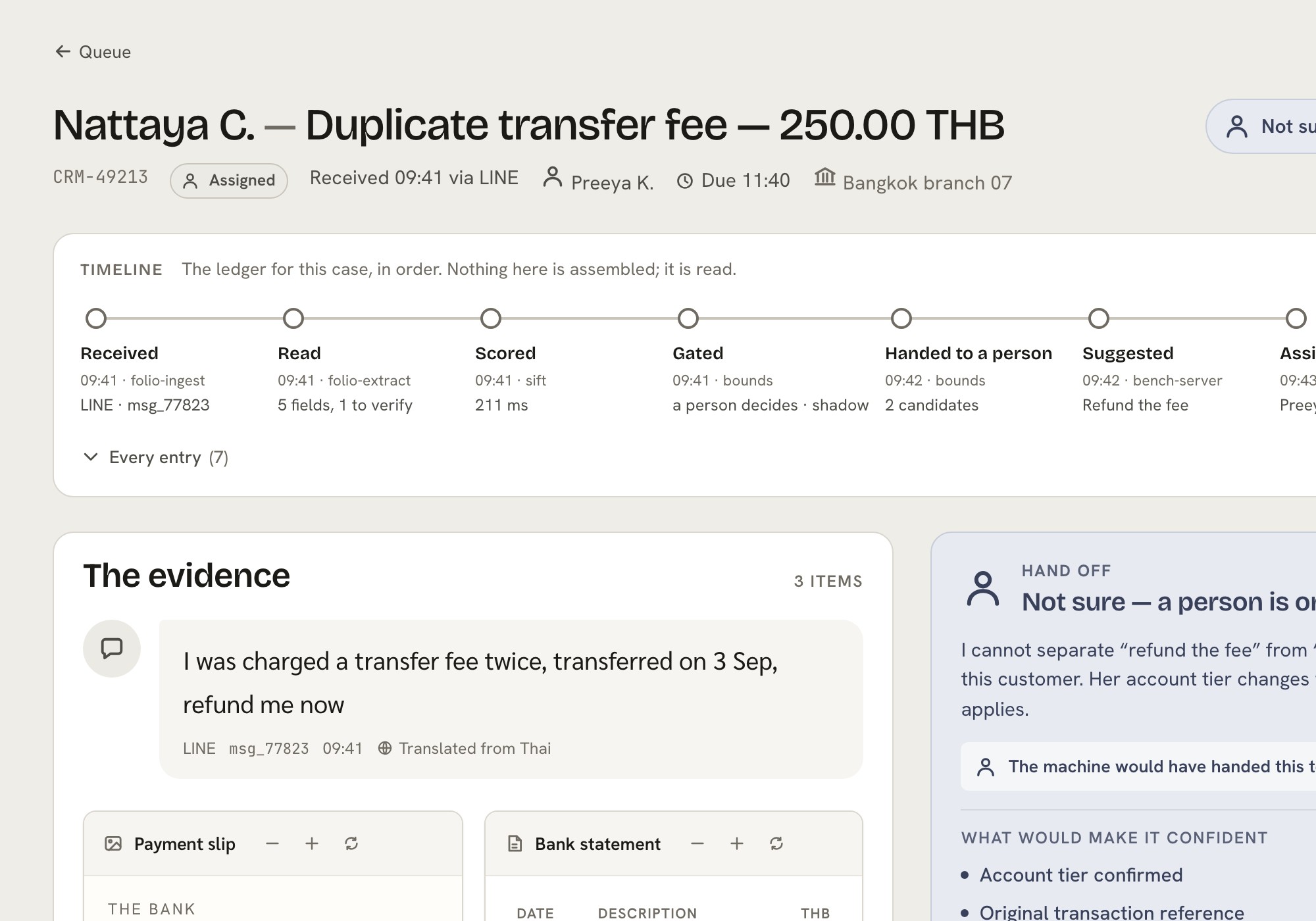
Captured from the REMIT console demonstrator; the case data and figures are illustrative
Complaint handling carries statutory response deadlines, and transaction-monitoring queues are dominated by false positives. Both are cost problems with numbers attached, and both must survive an audit.
Illustrative scenario
A morning with REMIT
09:41
A complaint arrives on LINE
A customer sends a Thai voice note and a photo of a transfer slip: charged a fee twice, wants a refund. REMIT transcribes the note, reads the slip and the statement, and finds the two fee draws on the actual lines.
09:42
The policy that decides it
Fee Schedule 4.2 allows reversal of a duplicate draw within 30 days; Complaint SOP 7.3 says the remedy depends on the customer’s segment. Both passages are attached to the case, with the deciding phrase marked.
09:42
The system is not sure
Refund the fee, or a goodwill credit instead? The segment rule makes both plausible. REMIT does not guess. The case goes to Preeya, the case officer, as a hand-off with the evidence and what would settle it: the account tier.
09:47
A person decides, and it is recorded
Preeya confirms the tier, approves the refund, and the payout runs through the payment connector with a reply to the customer in Thai. A signed proof record is filed. Meanwhile, 168 routine cases that morning were cleared without her, each with its evidence.
The reviewer’s daily surface
What your case officers see
Cases arrive already read, with the outcome the system is sure of or the two it could not separate. Nothing on this screen is a probability; the state is the confidence.
Needs you 3
- Hand off
Nattaya C.
Duplicate transfer fee — 250.00 THB
Not sure — a person is on it. “Refund the fee” or “Reject the claim”
- Verify
Ali F.
Card fee after cancellation — 300.00 THB
Likely — please verify.
- Refer
Nguyen T.
Currency conversion fee on a baht account
I have not seen a case like this.
Handled without you this morning 168
- Handled
Kanya W.
Duplicate transfer fee — 120.00 THB
This is taken care of. Here is why.
What changes
For your team
The queue shrinks to what needs judgement.
Routine cases are cleared and filed with their evidence. Your people open the ones where two outcomes are possible, with the evidence already assembled.
Deadlines stop being a scramble.
Every open case shows what would make it decidable and when it is due. Requests to the customer are pre-filled from what is missing.
Audit preparation is already done.
Each decision carries a signed record: what was read, what was decided, by whom, against which standard. Export it; nothing to reconstruct.
What stays with people
- Any case where two outcomes are plausible
- Anything the system has not seen before
- Fraud escalations and account actions
Built and benchmarked first on the regulator’s public complaint corpus, so our claims can be checked before we see your data. Accuracy on your own complaints is measured on your own past cases before anything goes live.
What you get
Delivered inside your environment
- Document intake for your channels and formats
- A model trained and measured on your own past cases
- Your list of outcomes and decision rules, agreed with your experts
- The reviewer console for your case officers
- A signed proof record on every decision
- A compliance package mapped to your regime
What the regulator gets
Every decision carries a signed record: what was read, what was decided, by whom, and against which standard. Verifiable with your own key, without us in the room.
How to start
Two weeks in shadow mode, on your own banking cases.
REMIT is installed on one server inside your perimeter, reads and scores every live case, and executes nothing. Your people decide everything. After two weeks you read how often they agreed with it, per outcome, before licensing anything.
Ready to scope an engagement?
A 30-minute call. From there, the first paid step is an Air-gap readiness assessment or a Discovery engagement.
Start a conversation