Integrations
What ships, and what is a declared contract.
Every entry is either an adapter specified for the first release or a connector contract a bank or partner builds against. The distinction is stated per row, because “we integrate with X” means something different from “you can build X”.
The specified v1 catalogue
What version one specifies
The integrations the first release is specified to carry, as written in the product specification. The API tier is specified and not yet implemented; it is described here and linked nowhere until it exists.
| Integration | Direction | Why this one |
|---|---|---|
| SFTP hot folder and core-banking SFTP | in | Every bank has a nightly export. The zero-integration path to a pilot on historical files. |
| Email journal feed (IMAP) | in | Complaint intake’s actual channel; headers kept as metadata. |
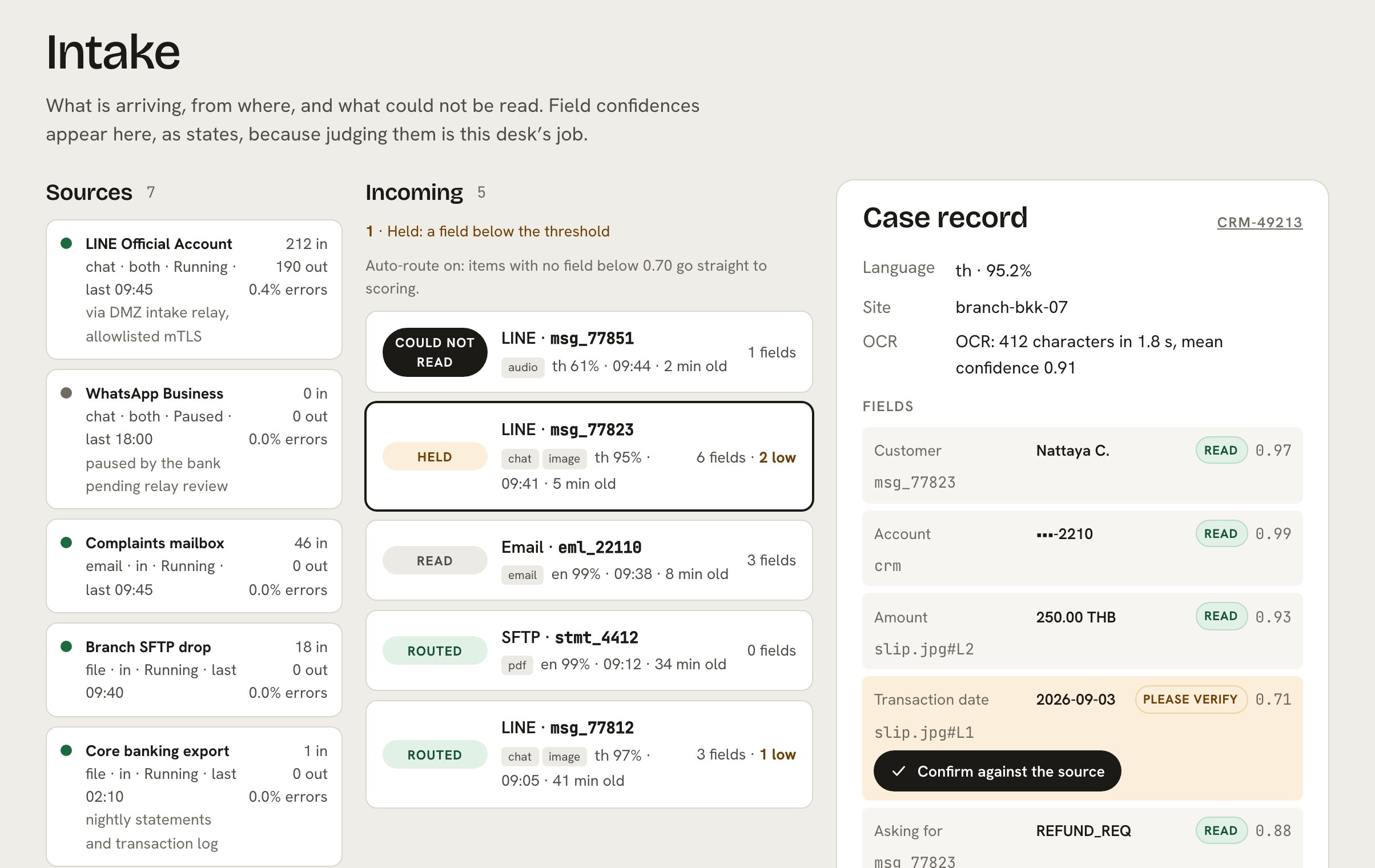
| LINE Official Account | in / out | The channel Thai retail customers open. Required for the first workflow. |
| WhatsApp Business | in / out | Regional parity with LINE, same relay path. |
| CRM write-back, generic REST | out | The ticket closes in your system of record. One contract instead of three bespoke connectors. |
| Payment hub and slip generation | out | Executes the refund, so ‘executed’ on a proof record is an event, not a label. |
| POST /v1/ingest and scoped reads | in | The developer surface: versioned, idempotent, explicit status semantics. |
| Outbound event delivery | out | Your SIEM, SLA board, GRC tool and CRM subscribe to the same ledger projection. |
| POST /v1/verify | out | Continuous proof-record verification for GRC. The offline kit remains the proof path. |
Declared contracts
Built by you or a partner, installed without a code release
A connector declaration names its schema in and out, retry policy, egress allow-list entry, owner and mode. It is staged shadow, then gate, then auto, exactly like a workflow, and rollback is one action.
SAP / Oracle ERP financial posting
Posting a refund or write-off to the general ledger. A per-customer mapping exercise against the contract plus a reference implementation, not a turnkey badge.
Salesforce / ServiceNow native
Declared where the generic REST write-back proves insufficient for a specific customer.
Reviewer notifications
Teams, Slack or your paging path, for breach projections, customer replies and dual-signature requests. Pushes to channels you already own.
Real-time core-banking events
Event-driven intake instead of the nightly file, where your streams exist and latency demands it.
The API tier
Built for machines that are not users
Machine principals, not accounts.
Client certificates from your own CA, carrying scopes (which workflows, which directions) and a named human owner. A principal can never hold an administrative role.
Versioned ingest with honest status codes.
POST /v1/ingest is idempotent and pinned to the workflow’s extraction schema. 409 means your duplicate was already accepted; 422 means one field is wrong and you can retry; 503 tells you how long to back off.
Outbound is the ledger, subscribed to.
case.created, decision.sealed, decision.executed, sla.breach_projected, calibration.stale, drift.alarm and the rest are the audit trail’s own entry kinds, filtered by scope. One source of truth.
Verification as a monitored control.
/v1/verify returns the same verdict as the offline auditor kit, so your GRC tool can verify records continuously. The API is for convenience; the offline kit is for proof.
Nothing crosses unlogged.
Registration, revocation and every authenticated call are ledger entries. A dead-lettered outbound event is a screen in administration, because a CRM that stopped receiving decisions is an incident.
The API reference is generated from the declared contract. Integration guides follow during implementation.
Deliberately absent
Four refusals, so they are not read as oversights
No “ask the model” endpoint.
There is no path to a score without a case, a workflow, a gate decision, a proof record and a ledger entry. The guarantee is per decision, so the decision is the only unit exposed.
No bulk export of personal data.
Integrations read cases through scoped, masked surfaces. Export crosses the boundary through the write-once path with a manifest, reviewed and retained.
No remote authoring of what the machine may decide.
Workflows are built inside your perimeter and cross into production physically. No integration scope can change them.
No egress to any cloud model.
There is no connector class that can punch through the air gap. If you need a cloud model, we are not the right vendor, and we would rather say so here than in a discovery call.
Deliberately absent
Not in the product, on purpose
Three things competitors advertise that we refuse
A buyer comparing REMIT with a horizontal AI platform or an agent builder will notice these as missing. They are load-bearing.
No no-code agent builder.
A workflow is a signed artifact carrying a calibration set and a measured guarantee. It cannot be generated from a prompt and still carry either.
No outbound voice, SMS or email channel.
We are the decision layer. Your contact centre consumes the ledger subscription; the event catalogue is the interface, and your channel stays yours.
One pinned model, not model-agnostic.
Swapping the model invalidates the calibration record the proof signs. Reproducibility is the product, so the model is pinned per release in the build provenance and the cartridge refuses to activate on any other.
Building against it?
Partners deliver signed connector declarations for systems we have never seen, installed and revoked by the bank without us.